Commercial excavation and residential excavation run on the same five phases and often the same machines. What changes is who signs off. A residential pad answers to a property owner and a building inspector. A commercial pad answers to a general contractor, a civil engineer, a testing lab, and a jurisdiction that wants documentation at every step.
Most comparisons stop at “commercial is bigger.” True, and not very useful when you’re trying to figure out what your own project requires. Here’s what actually changes on an East Valley job site, plus two things that don’t change at all no matter how small the job is.
Commercial vs. Residential Excavation at a Glance
Question: What’s the difference between commercial and residential excavation? Answer: Commercial excavation covers larger footprints built to engineered tolerances, with soil testing, formal permitting, and inspection sign-offs. Residential excavation is smaller in scale with looser tolerances and lighter permitting, though soil conditions, equipment, and air quality rules are often identical.
| Factor | Commercial | Residential |
| Typical footprint | Building pads, parking lots, multi-acre sites | House pads, additions, pools, driveways |
| Grade tolerance | Engineered spec, often tenths of a foot | Drainage-driven, checked visually |
| Compaction testing | Third-party lab reports standard | Rarely required |
| Stormwater permitting | Required at one acre or more | Usually below the threshold |
| Dust permitting | Required | Required on most jobs (see below) |
| Who you coordinate with | GC, engineer, inspector, other trades | Owner, sometimes a builder |
| Schedule pressure | Fixed hold points, trades waiting | Flexible, weather-driven |
The Real Difference Is Paperwork, Not Horsepower
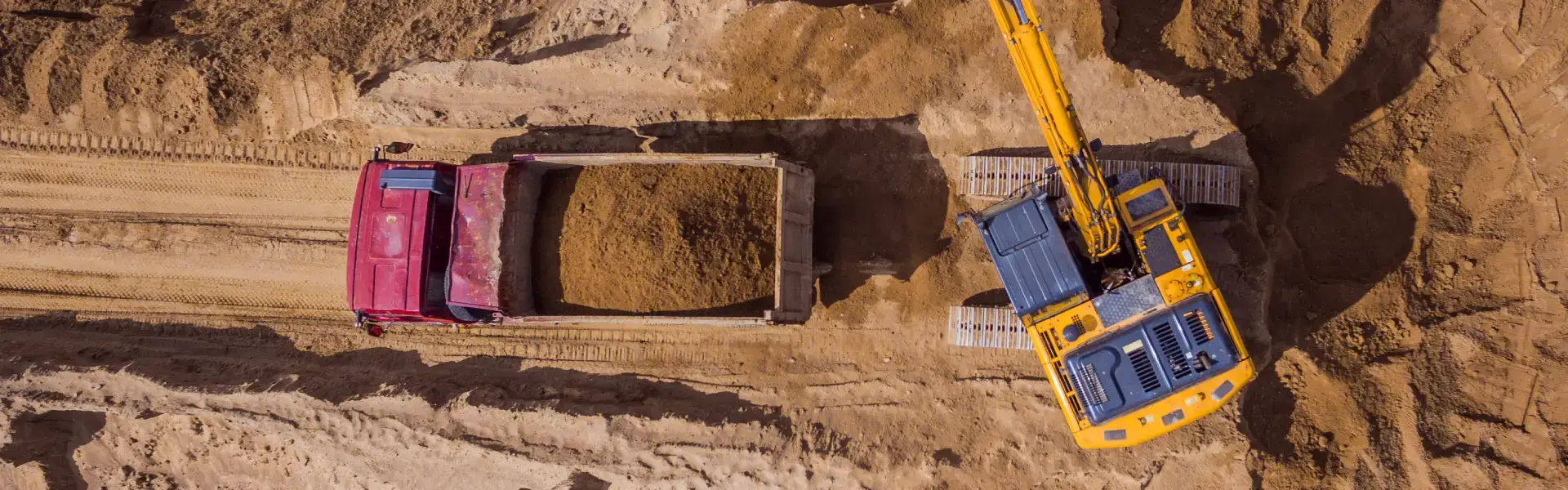
The excavator cutting a commercial pad in Queen Creek is frequently the same class of machine cutting a house pad two miles away. What separates the two jobs is almost entirely off the machine.
Stormwater and Site Permits
A commercial site that disturbs one acre or more needs coverage under Arizona’s stormwater Construction General Permit, which means filing a Notice of Intent and having a Stormwater Pollution Prevention Plan written before ground breaks. ADEQ administers that permit, and the one-acre line is the trigger, not the project’s category. A quarter-acre house pad sits well under it. A five-acre residential subdivision does not.
Grading permit thresholds are set locally and vary between Pinal County, Maricopa County, and each incorporated city, so that one is worth a phone call rather than an assumption.
Compaction Testing and the Lab Report
On commercial work, a third-party lab tests subgrade compaction against a Proctor value and issues a report before concrete gets scheduled. Short numbers mean the crew reworks the subgrade. That test is a hold point, and it’s the single biggest scheduling difference between the two job types.
Residential excavation rarely involves a lab. That doesn’t make compaction less important — a settling house pad cracks a slab exactly the way a settling commercial pad does. It means nobody is checking except the contractor.
Pro Tip: On a residential job with no required testing, ask how your contractor is confirming compaction anyway. A crew that can describe lift thickness and moisture conditioning is doing it right. A shrug means the pad is untested.
Two Rules That Don’t Care How Small Your Job Is
Here’s where most comparison articles get it wrong, and it costs homeowners real money.
Dust control permits are not a commercial-only requirement. In Maricopa County, Rule 310 requires a dust control permit for any activity disturbing 0.1 acre or more. That’s 4,356 square feet — a pool excavation plus a driveway can clear it. Pinal County applies the same 0.1-acre threshold, and parts of the county carry extra construction rules because they sit in a PM10 nonattainment area. A homeowner who assumes dust rules apply only to big sites is the one holding the violation.
Utility locates apply to everything. Arizona law requires contacting Arizona 811 at least two full working days before digging, excluding weekends and state holidays, and you can’t start until every utility on the ticket has responded. That applies to a subdivision and to a fence post.
Did You Know: Arizona law also requires hand tools only within 24 inches of a marked utility line. That rule alone is why a small trench near an existing water service sometimes takes a crew longer than a much larger open cut.
Where Arizona Soil Erases the Difference Entirely
Caliche doesn’t care what your permit says.
Caliche is a hardened calcium carbonate layer common across San Tan Valley, Queen Creek, and Florence. It sits anywhere from a few inches to several feet down, and standard bucket work won’t move it. When it shows up, the job needs a hydraulic hammer or ripping teeth regardless of whether the pad is 1,200 square feet or 12 acres.
We’ve hit caliche eight inches below the surface on a commercial pad in Queen Creek that didn’t appear anywhere in the pre-bid site walk. We’ve hit it on single-family additions where the owner had budgeted for a two-day dig. Rock breaking cost the same per cubic yard on both. That’s why a homeowner calling for a small excavation job sometimes gets a quote that looks commercial — the ground underneath is.
Did You Know: The assumption that residential excavation is always cheaper per square foot falls apart in caliche country. Small sites can carry a higher unit cost than large ones, because mobilization and rock-breaking equipment get spread across far less area.
Schedule and Coordination
Commercial excavation is one link in a chain. The concrete contractor, the plumber running underground, and the electrician waiting on trenching are all scheduled against the date the pad certifies. Slipping two days doesn’t cost two days — it costs your place in everyone else’s calendar.
Residential work is usually self-contained. The property owner sets the pace, and the main outside pressure is weather. Arizona’s monsoon season runs June 15 through September 30 under the National Weather Service’s official dates, and saturated caliche takes longer to break and longer to compact. That pushes summer schedules on both job types.
Pro Tip: If your residential project sits near a commercial build, ask whether your excavator is working both. Sharing mobilization across two nearby sites can trim real cost off a small job.
What This Changes About Your Estimate
A commercial bid is priced against plans, a soils report, and named tolerances. A residential bid is priced against a site walk and a conversation about what you want the ground to do. Neither is guesswork, but they’re built from different inputs, which is why comparing a commercial per-yard rate against a residential quote tells you almost nothing.
Both should spell out the same four things: excavation scope, rock contingency language, haul-off or on-site balance, and whether finish grading is in or out. Get that last one in writing. It’s the most common gap in the competing bids property owners bring us to compare. For how the excavation phases fit together start to finish, our complete guide to excavation in construction walks the whole process.
Scale and paperwork separate commercial excavation from residential excavation. Arizona dirt and Arizona air quality rules treat both the same. A crew that knows where caliche sits in your area and which permits your parcel triggers is worth more than one that specializes in your project category.
Mirage Excavation works with general contractors, developers, and property owners across San Tan Valley, Queen Creek, Mesa, Gilbert, and Casa Grande. Contact us for a free estimate and we’ll walk your site, review your plans, and give you a scope you can actually compare against another bid.
Frequently Asked Questions
What is the difference between commercial and residential excavation?
Commercial excavation covers larger footprints built to engineered tolerances with lab compaction testing and formal inspection sign-offs. Residential excavation is smaller with lighter permitting, though equipment and soil conditions are frequently identical.
Is commercial excavation more expensive than residential?
Total cost is higher because the scope is larger, but cost per square foot is sometimes lower. Small residential jobs spread mobilization and rock-breaking equipment across far less area, which raises the unit price.
Do residential excavation projects need a permit in Arizona?
Often, yes. Maricopa and Pinal counties both require a dust control permit for disturbances of 0.1 acre or more, and grading permit thresholds vary by jurisdiction. Contacting Arizona 811 is required on every job regardless of size.
Can the same contractor handle both commercial and residential excavation?
Yes, provided their ROC license classification covers the work. Mirage Excavation runs commercial and residential projects with the same crews and equipment, scaling scope and documentation to what each job requires.
Does caliche affect residential excavation the same way it affects commercial?
Yes. Caliche requires hydraulic hammers or ripping teeth regardless of project size, so a small residential dig can carry the same rock-breaking cost per cubic yard as a large commercial pad.
Related East Valley service area: Mesa – For related local work, visit our excavation contractors in Mesa page.